Ice Maker Repair
Sub-Zero Airflow Fixes That Don't Need a Certificate of Appropriateness: Willo and Encanto
In Willo and Encanto, exterior alterations go through historic design review, so Sub-Zero ice maker faults have to be solved inside the house. Here is the order to check water pressure, filter, mould, drain and condenser air before suspecting the module.
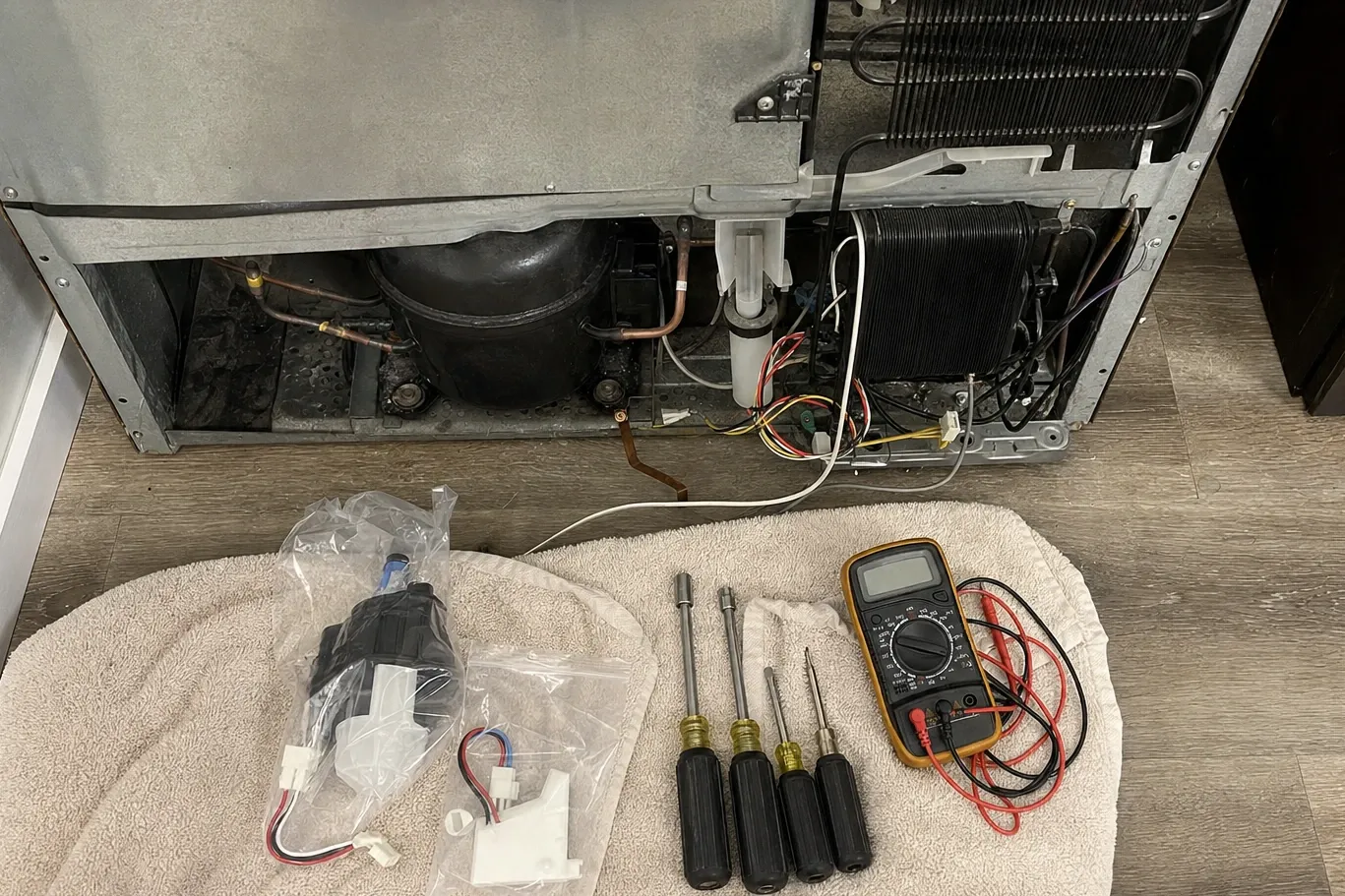
There is a category of ice maker fix that a Willo or Encanto homeowner cannot simply decide to have done: anything that puts a new opening, a new grille or a new line through an exterior wall. That single constraint is why good ice maker work in these two neighbourhoods is designed to stay entirely inside the house.
What people here assume is wrong with it
Most owners arrive at the same conclusion: the ice maker module has failed and needs replacing. Occasionally true. Far more often the module is doing exactly what it was told, and the problem is upstream of it — the water reaching the fill valve, the drain leaving the bin, or the air the compressor compartment is not getting.
That matters because module replacement is the one repair people are willing to guess at, and a guessed module fixes nothing when the cause is a restricted fill or a smothered condenser. The ice comes back for a fortnight and the call repeats.
What is actually happening
Sub-Zero ice production depends on two supplies: clean water at adequate pressure, and enough air moving through the compressor compartment to reject heat. Starve either one and the machine does not stop — it slows. Cubes come out hollow, cloudy or fused, production falls to a handful a day, and nothing on the display suggests a fault.
Phoenix conditions push on both supplies at once. City water here is hard enough that scale accumulates in fill valves, tubing and the freezing mould, which narrows the fill and changes the shape of the cube long before it stops the machine. Meanwhile the air side is fighting a garage or patio installation in Desert Ridge, or a 1920s Encanto kitchen where a column was retrofitted into cabinetry that was never built around a ventilation gap.
The obvious cure for the air side — cut a louver, move the condensing unit outside, run a fresh exterior water line — is exterior work. In Willo and Encanto-Palmcroft, that is the cure you cannot have.
The evidence, in the order we look at it
Work the symptom, because the symptom names the supply. No ice at all points at water: shutoff, filter, inlet valve, or the module’s own harness. Hollow, cloudy or fused cubes point at fill volume and freeze time, which usually means scale or a restricted line. Water sitting in the bin points at the drain. Ice that forms but slowly, with the cabinet otherwise warm-ish, points at heat rejection.
The order on site is fixed. Confirm supply pressure at the shutoff behind or below the unit. Check the filter’s age, since a filter past its interval is the cheapest thing on this list and the most commonly overlooked. Inspect the fill tube and mould for deposit. Clear and test the drain. Then pull the grille and look at the condenser and the air path — a coil packed with Laveen-grade dust or a toe-grille blocked by a kickboard is a five-minute finding that explains a fortnight of poor ice. Only after all of that is the module worth suspecting, and by then the readings say so.
The fix that holds
The durable fix in a historic district is an interior fix. Restore the airflow path that already exists rather than making a new one: clear the toe-grille, correct the compartment’s intake and discharge separation, pull the coil properly, and give the cabinet the service reveal it was supposed to have. Feed the ice maker from interior plumbing on a line sized and filtered for it. Then set a descaling and filter interval and keep it, because in this water the interval is the maintenance.
This is not a stylistic preference. Under the Phoenix Zoning Ordinance and the city’s Historic Preservation Office, a building permit application affecting the exterior of a property on the Historic Property Register — including non-historic properties inside a district — needs either a Certificate of No Effect, which is over-the-counter staff approval for minor work that falls within the general design guidelines, or a Certificate of Appropriateness, which requires a public hearing before an independent hearing officer. Willo, with over 900 homes built between the 1920s and 1940s and a National Register listing in 1991 according to the district’s own published history, sits under that framework, as does neighbouring Encanto-Palmcroft. Desert Ridge and Camelback East do not, so the same fault there can be solved with a saw. Here it has to be solved with method.
Where to stop and call
Stop when the answer requires opening the sealed refrigeration circuit, when the drain will not clear with a proper flush, or when the fill valve, module or control are genuinely implicated by the readings rather than by elimination. Stop immediately if the fix under consideration involves cutting the outside of a Willo or Encanto house — that is a design-review question before it is a repair question.
A diagnostic call is $89 and ends with a named cause. From there, ice maker, water valve or supply line work runs $290 to $830; an evaporator or condenser fan motor is $330 to $720; a defrost heater, thermostat or sensor is $300 to $600; an electronic control board is $410 to $1,000. Reach us on (623) 323-5056 or through the booking link on this page.
Follow-ups
Do I need city approval to repair an ice maker in Willo?
Not for interior work. Historic design review attaches to permit applications affecting the exterior of a property on the Historic Property Register, so replacing a fill valve, clearing a drain or servicing a condenser inside the house is unaffected. The moment a fix means cutting a louver or running a fresh line through an outside wall, it becomes a review question.
Why is my Desert Ridge ice cloudy and fused together?
Cloudy, hollow or clumped cubes normally mean the mould is not filling or freezing as it should. Here that is most often mineral deposit narrowing the fill path, a filter well past its interval, or a freeze cycle stretched out by poor condenser airflow. A failed module tends to produce no ice at all rather than bad ice, so water and air get checked first.
Can a vent be cut for a column retrofitted into an Encanto kitchen?
A new opening in an exterior wall inside the district goes through review: either an over-the-counter Certificate of No Effect for minor work that fits the design guidelines, or a Certificate of Appropriateness, which requires a public hearing. In practice the airflow fix is designed around the existing toe-grille path so the question never has to be asked.