Refrigerator Repair
Best Sub-Zero for Your Kitchen Layout: How Each Design Works
The best Sub-Zero for your kitchen layout is a Classic when the fridge stands alone or shows a side, a Designer when it must hide behind cabinet panels, and a PRO when you want stainless on show. Here is how each design works in a Phoenix kitchen.
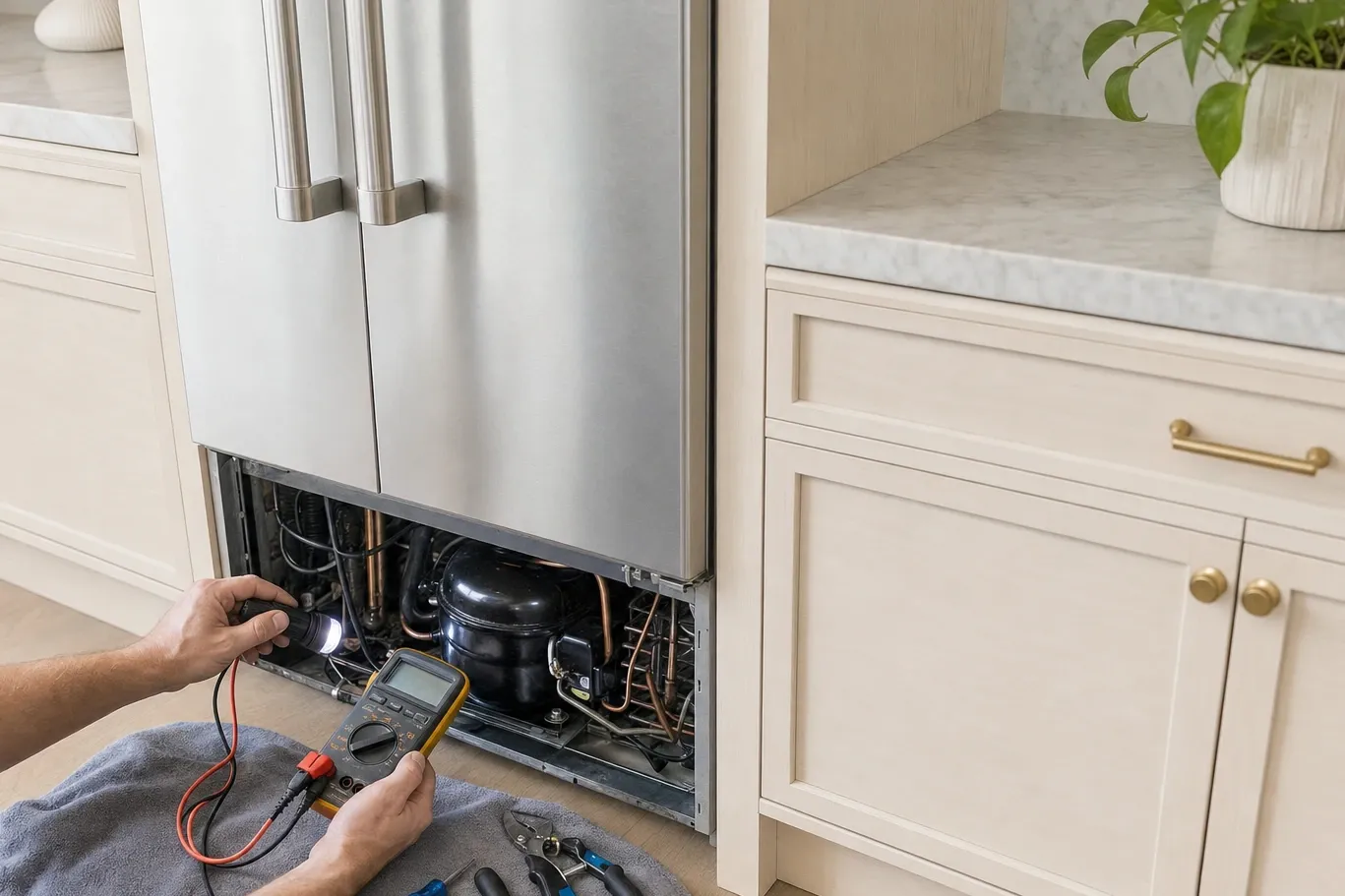
The best Sub-Zero for your kitchen depends first on how much of the unit will be visible once it is in place. If it will stand on its own or leave a side exposed at the end of a cabinet run, Sub-Zero steers buyers toward the Classic line. If it has to vanish behind panels that match your cabinets, a Designer unit shows less metal and is made to blend in. If you want stainless steel on show and a separate control for each compartment, PRO is the third road. Once the line is settled, the floor plan picks the format: one wide combination, a pair of columns, or drawers under the counter. In Phoenix that choice carries extra weight, because every built-in breathes through its front grille, and a kitchen that runs warm all summer leaves little slack for a grille that is boxed in.
Three lines, sorted by how much of the box shows
Sub-Zero renamed its refrigeration lines in March 2019, and the old names still turn up on tags, manuals and resale listings, so it helps to know both. What used to be called Built-In is now Classic, the former Integrated series became Designer, and PRO kept its name.
The letters in the model number tell the same story. Legacy Classic models carry BI and were built from 2008 to 2022; the current Classic models carry CL and went into production in 2022. On the Designer side, the tall and column models labelled IT and IC ran from 2014 to 2022, the current DET and DEC models took over in 2022, and the Designer drawers marked ID are still being made.
The practical split is simple. A Classic has a stainless face or a framed panel and looks right when part of its cabinet is exposed. A Designer takes a custom panel and sits nearly flush, so the fridge reads as one more tall cabinet. A PRO is the bold stainless look, meant to be seen.
Matching the format to your floor plan
One wide unit on a single wall
If you have one stretch of wall and want everything together, a combination refrigerator-freezer is the natural fit, and the model number spells out what you are buying. Take two examples from Sub-Zero’s model key. DET3050CIID/R is a 30-inch Designer that holds both fresh and frozen food, adds an ice maker and a dispenser inside the door, and hangs its door on the right. CL3650RA/S/P/L is a 36-inch Classic given over entirely to fresh food, fitted with glass rated for high altitude, a stainless skin, a pro-style pull and hinges on the left. That hinge letter deserves more thought than it usually gets. A door that swings out into the path between the fridge and an island becomes a daily annoyance, so pick the hinge side from the way people actually walk through the room.
Columns when the wall is split
Columns put the refrigerator, the freezer and wine storage in separate cabinets. You can set a full refrigerator column near the prep counter and the freezer farther away, or flank a pantry with matching units. Kitchens in the older homes of Willo and Encanto were rarely planned around one wide built-in, and two narrower columns can sometimes fit where a single 36-inch box will not.
Drawers and undercounter units for islands
Open plans with a long island, the kind you see in many Desert Ridge homes, suit refrigerator drawers in the island and an undercounter ice maker at the bar. Designer drawers (ID) and the DEU undercounter units tuck below the counter, while the UC-15I and DEU1550I are dedicated ice makers. If you plan to lean on the ice maker inside a combination unit, expect a gentler pace: Sub-Zero rates in-unit ice makers at 64 to 96 cubes a day, about 8 cubes weighing 4.6 oz every 2-3 hours, and an empty bin can need 2 days to fill. A household that hosts often through the hot months may want a separate undercounter unit.
How Dual Refrigeration works, and why it changes the choice
On many Sub-Zero units the refrigerator and the freezer do not share one cooling system. The Classic Series guide describes Dual Refrigeration as two independent systems, which keeps food odors away from frozen food and ice and avoids stripping the moisture out of the fresh-food air. PRO models carry three controls instead of two, which means the main fresh-food section, its drawers and the freezer can each be set on their own, using a pair of touch displays built into the grille.
On older 200 and 300 Series combinations you can count the systems straight from the model number: each 1 stands for a compressor and a control, so a 361RFD has one and a 3211RFD has two. The 211 breaks the pattern with just one. This is where the design meets the symptoms owners type into a search bar. A two-system unit can lose cooling in one compartment while the other stays perfectly cold, which puzzles people who expect a fridge to fail all at once. A single-system unit tends to warm up everywhere together.
Why a tight layout can leave a Sub-Zero warm
A built-in has cabinets on both sides and a wall behind it, so it cannot shed heat the way a freestanding fridge does. It draws room air in through the grille, passes it across the condenser and sends the warmed air back out the front. Full-height units do this at the top, while undercounter models breathe at the toe-kick. Anything that crowds that path, such as a decorative valance, a cabinet door that overlaps the grille or a toe-kick panel fitted too low, forces the compressor to run longer to hold temperature.
Placement adds to the load. A fridge beside a dishwasher, in afternoon sun from a west-facing window, or in a niche with no air movement starts from a warmer room. During a Phoenix summer, when the whole house is fighting the heat, a cramped installation can be the difference between a unit that copes and one that drifts warm. Our guide to condenser heat through a Phoenix summer covers the warning signs. When you draw up a new layout, leave the grille completely open and keep the unit out of the hottest corner of the room.
Before replacing a unit just to change the layout
Plenty of remodels begin because the old fridge quit. Before pricing a new one, find out how old the current unit is. Its age is printed on the serial tag. If you own an over-and-under Classic, 600, 500 or 200/300 Series model, look near the upper hinge on the inner face of the fresh-food door; on a side-by-side, open the freezer door instead, and on a Designer column, check inside the middle drawer by the guide across from the hinge. For context, 600 Series units were built from 1996 to 2009 and 500 Series units from 1987 to 2003.
Even a compressor or sealed-system repair usually runs $1,300–$3,200, and a failed fan motor $330–$720, which is a fraction of what a comparable new built-in costs; the firm figure comes after diagnosis. Current Sub-Zero guides warn that the units contain flammable refrigerant and that only technicians trained for it should work on them, so sealed-system work is never a weekend project. Our flat $89 visit covers the trip and the full diagnosis, and it is credited toward the repair once you approve it. For built-in refrigerator repair anywhere from Camelback East to Desert Ridge, call (623) 323-5056.
Follow-ups
Apart from the cabinetry, what sets a Sub-Zero apart from a typical kitchen fridge?
Most of the gap comes from Dual Refrigeration: on many Sub-Zero models the refrigerator and the freezer each run on their own system instead of sharing one. That keeps freezer air and ice free of fresh-food smells and stops the fresh-food side from drying out. Because they are boxed in, built-in units also take in and release air only through the front grille.
Can a Sub-Zero go at the end of a cabinet run with one side showing?
Yes, and Sub-Zero points buyers to its Classic line for that spot, as well as for a unit that stands freestanding. Designer models show less metal and are meant to be wrapped by cabinetry, so a Designer at the end of a run usually needs a finished cabinet side built around it.
Can the layout be the reason my Sub-Zero is not cooling?
It often is, because a built-in can only take in air and release heat through its front grille. If trim, an overlapping cabinet door or a low toe-kick panel crowds that grille, or the unit sits in a hot corner, the compressor runs longer and the fresh-food side drifts warm. Clear the grille first, then call (623) 323-5056 if it stays warm.
How do I find out how old my Sub-Zero is before planning a remodel?
Check the serial tag, because it is printed with the date the unit was built. Owners of over-and-under Classic, 600, 500 and 200/300 Series models will find it up by the top hinge on the inner face of the fresh-food door. On a side-by-side, look inside the freezer door; on a Classic French-door model, open the left door.