Refrigerator Repair
Why a Sub-Zero condenser struggles through a Phoenix summer
A built-in that cooled fine in April and slides in June is usually not broken in the way people fear. Here is what the heat changes, the four things we find behind the grille, and what you can check before calling anyone out.
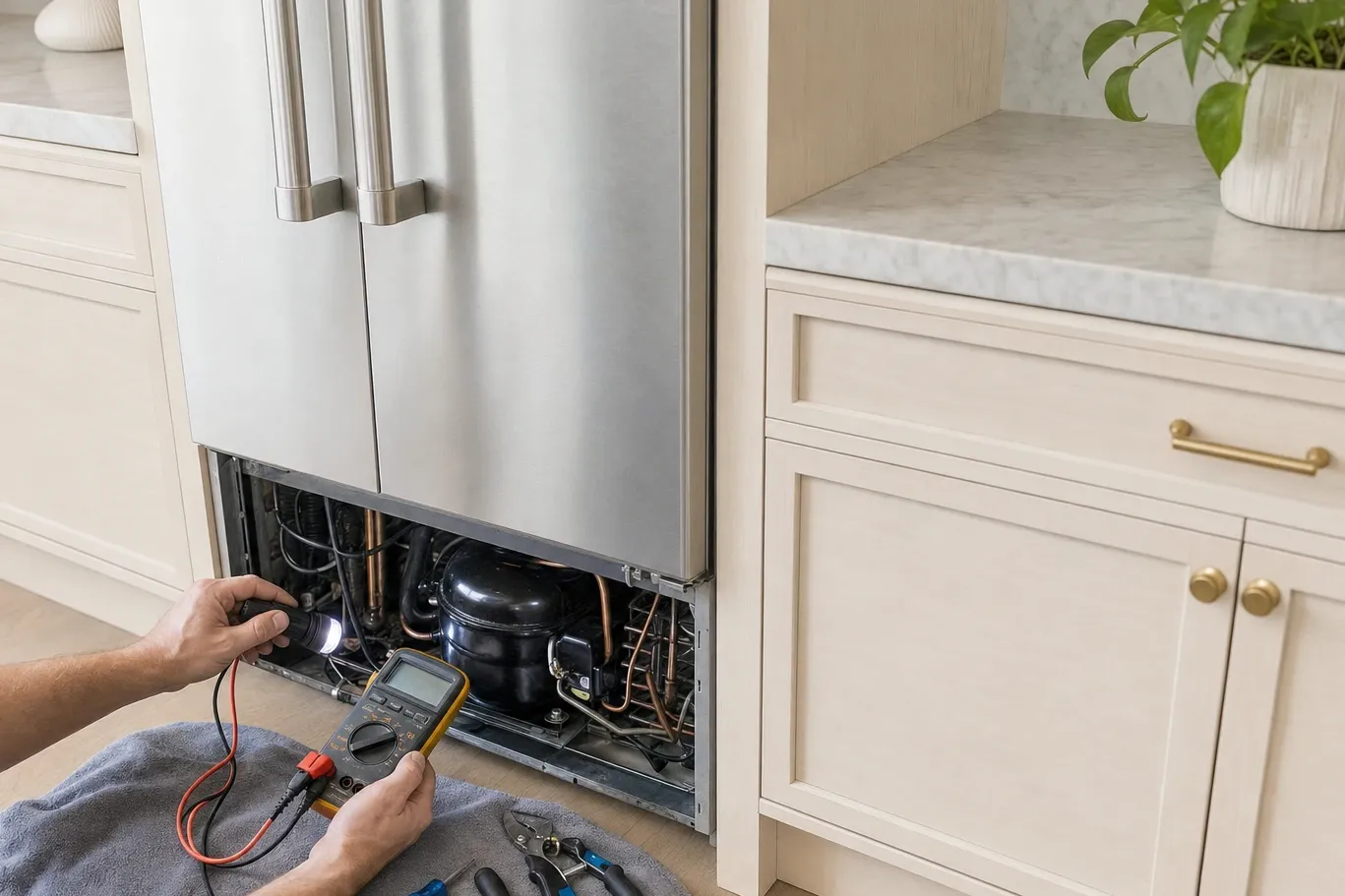
Every June we take the same call. The refrigerator was perfect all spring, then over a week or two the fresh-food side starts drifting up, the compressor seems to be running whenever anyone is in the kitchen, and the ice cream has gone soft at the edges. Nobody dropped anything, nobody changed a setting, and the unit is not making any new noises. It just is not keeping up.
Nine times out of ten this is not a failing sealed system. It is a heat-rejection problem, and in this valley heat rejection is the whole ballgame from May to September.
What the heat actually changes
Cold is not something a refrigerator manufactures. The machine is a heat pump: it collects warmth from inside the cabinet and hands it over to your kitchen, and the handover happens at the condenser coil behind the grille. How readily the heat leaves comes down to one figure — the difference between the refrigerant sitting in that coil and the air being drawn across it. Widen that difference and the coil sheds heat easily. Squeeze it and everything downstream gets harder.
In a mild climate the kitchen sits at 70 degrees and the coil has an easy job. In a Phoenix kitchen in July the air behind the grille can be well over 100 degrees before the unit has done anything at all, and a built-in is pulling that air through a narrow slot at the bottom of a cabinet run. The gap narrows, the transfer slows, head pressure climbs, and the compressor has to run far longer to shift the same amount of heat.
Everything the unit was designed to tolerate is still true — it just has no margin left. Which means any second problem that would have been invisible in April, a coil with a season of dust in it or a condenser fan turning slowly, is suddenly the difference between holding 38 degrees and holding 46.
The four things we find behind the grille
In rough order of how often we see them on a summer call:
A coil packed with dust. Fine desert dust plus kitchen grease makes a mat that air will not pass through. It builds slowly, which is exactly why it goes unnoticed — the unit compensates for months until the weather removes its ability to compensate.
A condenser fan motor that has slowed or seized. These fail more here than anywhere, simply from hours run. A seized fan is obvious once you know what you are listening for; a fan that is turning but tired is not obvious at all, and it produces exactly the same symptom as a dirty coil.
No air path at all. Undercounter units are the worst offenders. If somebody built a cabinet around one without leaving a vent, or a wine unit was slotted into a run with a solid plinth in front of the grille, the air it exhausts is the air it takes back in. We see this in remodels that look immaculate.
A start component or relay on the way out. Heat is hard on these too. A compressor that hums for a second and stops, or trips a breaker on start-up, is usually a capacitor or relay rather than the compressor itself — which is a much better outcome than most people expect.
Notice what is not on that list: a refrigerant leak. They happen, and we do find them, but a leak is the least likely explanation for a unit that has degraded gradually as the season got hotter. A leak usually shows as a unit that cannot get down to temperature at all, with a compressor running non-stop and frost patterns in odd places.
What you can check before calling
Three things, in about ten minutes, with the unit switched off at the breaker for the first two.
Pull the lower grille and look at the coil with a torch. If you cannot see through the fins, that is your answer, or at least half of it. A soft brush and a vacuum, working with the fins rather than across them, gets most of it. Do not use a pressure washer or a screwdriver.
Then put your hand near the grille with the unit running again. You should feel warm air leaving. Nothing moving means the fan is not running, and that is a repair rather than a clean.
Finally, stop trusting the panel and take a real measurement. Half-fill a glass with water, stand it on a middle shelf on the fresh-food side, and give it four hours before you drop a thermometer into it. What the display shows you is air at a sensor — a twitchy number that jumps every time somebody opens the door — whereas the water reports the temperature your food has actually been sitting at. Two degrees either way changes what we load on the van before we set off.
When it is worth calling someone out
Call when the cabinet cannot reach its setpoint after a proper clean and a full night of running; when the freezer is fine but the fresh-food side is not, because that is an air-side fault rather than a heat-rejection one; when there is water anywhere it should not be; or when the unit trips the breaker.
Call quickly, rather than at the weekend, if the cabinet is above 45 degrees and full. In a 110-degree house a failed built-in loses its contents in hours, not overnight, and the food in a full column is usually worth several times the visit.
What we do on arrival is unglamorous and it is the whole job: gauges on the sealed system, amp draw at the compressor, fan and coil checked properly, temperatures logged at the duct rather than read off the panel. That tells us whether you have a dirty coil, a tired fan or something genuinely structural — and the difference between those matters enormously to what you spend.
Keeping it out of trouble until October
Clean the coil in spring and again after the monsoon, because that second dust load is real. Keep the grille clear — no baskets, no bins, no rugs pushed against it. If a unit is boxed in, get a vent cut into the cabinet; it is joinery work and it fixes the problem permanently.
And do not turn the setpoint down to compensate. A cabinet that is struggling to hold 38 will not hold 34, and all the lower setting does is add run hours to a compressor that is already working harder than it was designed to. Fix the airflow instead.
Follow-ups
How often should the condenser be cleaned in Phoenix?
Twice a year rather than once. Cleaning it in April and again in September puts the coil in its best shape for the two months that punish it hardest, and dust here is finer and more persistent than the maintenance schedule assumes.
Can I run a fan at the grille to help it through a hot spell?
It does help a boxed-in unit temporarily, and it tells us something useful: if a cheap fan blowing across the grille brings temperatures back down, the problem is airflow and heat rejection rather than the sealed system.
Is a refrigerator that runs constantly always a fault?
Not on a 112-degree afternoon — long run times are normal when the kitchen is hot. It becomes a fault when the cabinet still cannot reach its setpoint after hours of running, or when it never rests even overnight once the house has cooled.